


Why vitamin C decides whether your collagen works
Collagen you swallow doesn't arrive as collagen. Your body has to build it again — and the step that finishes the job doesn't run without vitamin C.

Here's the part most collagen products leave out. It isn't a secret and it isn't clever — it's in every physiology textbook.
Collagen you swallow doesn't arrive in your skin as collagen. It's broken down on the way, and what circulates is raw material. For any of it to become structure again, your body has to build collagen itself. That building step is enzymatic, and the enzymes that stabilise a new collagen strand cannot do their job without vitamin C.
Not "work better with". Cannot work without. It isn't an optional booster — it's a required part of the reaction.
Which makes it a strange thing to leave out
Most collagen supplements do. They pair the peptides with vitamin E, or with nothing at all, and the assumption underneath that is that your diet will cover the rest.
Usually it will. This isn't a scare story: vitamin C isn't hard to come by, and if you eat reasonably you're almost certainly getting enough. But it's the one link in the chain a formula can actually guarantee, it costs very little to include, and there's something odd about a product built entirely around supplying material that then leaves the step which uses that material to chance.
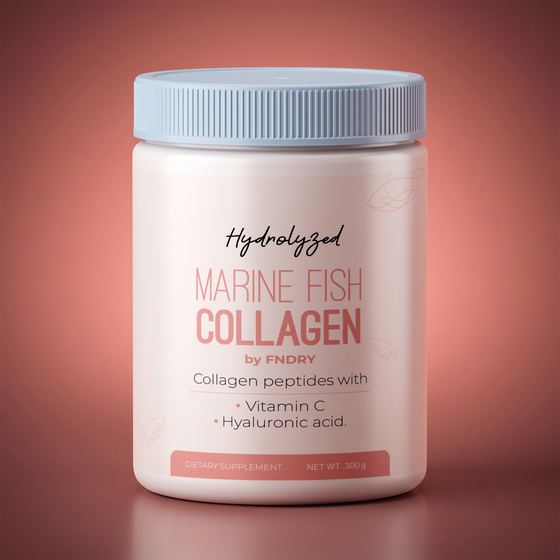
Per 10 g scoop
- Fish collagen peptide
- 4,500 mg
- Vitamin C
- 100 mg
- Acerola cherry extract
- 100 mg
Two separate entries, not one figure. The acerola is listed at its own amount rather than counted towards the 100 mg of vitamin C.
Why acerola as well
Acerola is a small red cherry from a shrub that happens to be one of the densest natural sources of vitamin C there is. It's in the formula alongside the ascorbic acid rather than instead of it, so the vitamin C in a scoop turns up both as the isolated vitamin and in the form it arrives in when it comes from food.
What this doesn't mean
It doesn't mean vitamin C does anything dramatic on its own, and it doesn't mean more of it is better — if you're already getting plenty, the extra isn't the hero of the story. And it doesn't mean that swallowing collagen sends collagen to your face. A formula can supply the material and make sure the step that uses it is able to run. It can't choose where the result ends up. That's a real limit, and it's better to know it before you start than to work it out afterwards.
This is the formula argument, and it's the only one
Most of what's in this range isn't here because we invented it. It's here because it's the right thing for what changes in your forties and fifties — that's the whole basis on which the four products were chosen, and we'd rather say so than dress each one up as a breakthrough.
The collagen is where a formulation decision genuinely changes the answer. Vitamin C is the one place in the range where what's in the tub decides whether the dose you take is a dose your body can use.
The full chain — swallow it, circulate it, rebuild it, stabilise it — is set out step by step on how it works, and every active in the scoop is listed in the ingredient library. If you're wondering why it's a scoop rather than a capsule in the first place, that's the other half of the argument.
Marine Collagen + Vitamin C contains fish and is not suitable for vegetarians. Supplements are there to support a diet, not to replace one.


