


How it works

What actually happens after you swallow it

Most supplement pages stop at what's in the tub. This one is about the step after that — what your body does with it, and what it needs in order to do anything at all. It's the reason there's vitamin C in our collagen, and the reason the ceramides are a capsule rather than a cream.

A woman in her forties at a sunlit kitchen counter, holding a glass of water

The collagen chain

Collagen synthesis has a step most formulas skip

Collagen isn't absorbed as collagen, and it isn't laid back down on its own. Here's the sequence, and the point in it where a formula either helps or it doesn't.

  1. You swallow it

    Collagen is a protein, and protein doesn't survive digestion intact. The marine collagen in a scoop is broken apart into short peptides and free amino acids long before it reaches anywhere useful. Nothing arrives in your skin as collagen.

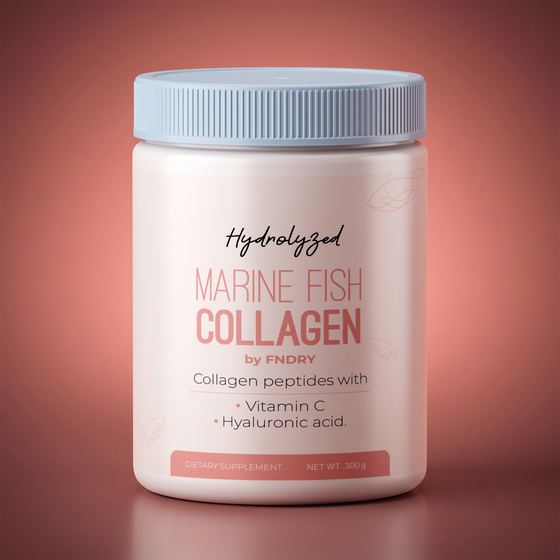
    4,500 mg marine collagen peptide per 10 g scoop

  2. It circulates as raw material

    Those peptides and amino acids — glycine, proline, hydroxyproline — enter the bloodstream and become available to the tissues that build connective tissue. At this point they are supply, not structure.

    Material in the blood, not collagen in the skin

  3. Your body has to build it again

    Synthesis is where collagen is actually made. Cells assemble those amino acids into new strands, then stabilise them so the strands hold their shape and their strength. That stabilising step is enzymatic — and the enzymes that run it cannot work without vitamin C.

    Vitamin C is a required cofactor here, not an optional extra

  4. Which is why the vitamin C is in there

    Every scoop carries vitamin C alongside acerola cherry, a natural source of the same. Most collagen powders pair vitamin E, or nothing at all. Ours pairs the one thing the reaction can't run without, so the dose you take is a dose your body can use.

    100 mg vitamin C + 100 mg acerola cherry per scoop

An open tub of FNDRY marine collagen on a kitchen counter beside a scoop of powder and a mug of coffee

In the tub

One scoop, both halves of the reaction

Ten grams, once a day, stirred into coffee or whatever you drink first. 4,500 mg of marine collagen peptide for the raw material, and 100 mg of vitamin C with 100 mg of acerola cherry for the step that uses it. Sodium hyaluronate, coenzyme Q10 and selenium sit alongside them.

Thirty scoops to a tub, which is a month.

A dose you can't use isn't really a dose.

See the collagen

The barrier

Skin is built from beneath

Everything you put on your face works on the top of it. The layer that decides how much water your skin keeps is built underneath, out of material your body makes — and makes less of after forty.

  1. What you put onSerums, oils, moisturiser. They work at the surface and above it.
  2. The surface you seeThe outermost cells, already on their way off. It's what a mirror reports, and the last part to change.
  3. The barrierCells set in a matrix of lipids, like brick and mortar. This is the layer that holds water in — or doesn't.
  4. CeramidesA large share of that mortar. Fewer of them, and the wall leaks.
A phytoceramide arrives here, from the inside.

The outer layer of skin is usually described as brick and mortar: cells held together by a matrix of lipids. Ceramides are a large share of that matrix. They are what stops water leaving faster than it arrives, and their absence is what tight, papery skin after a shower actually feels like.

Ceramide production falls with age, and the fall tends to steepen through the menopause transition as oestrogen drops. A cream can put ceramides on the surface, which is worth doing. A phytoceramide is swallowed, and works with the material the barrier is built from rather than on top of it.

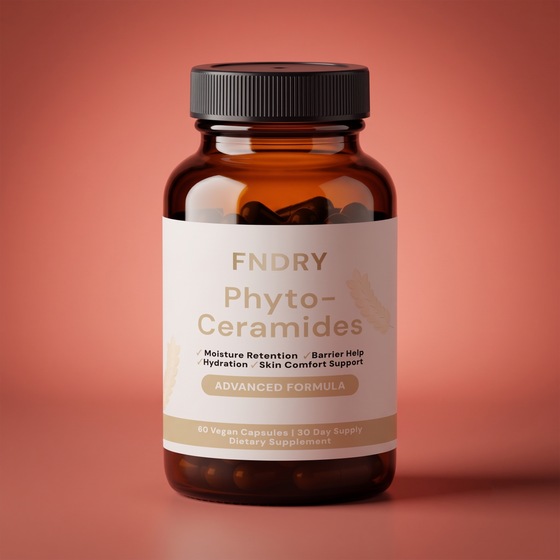
420 mg phytoceramides complex per serving, drawn from oat hull fibre, spinach, sweet potato, apple, konjac root and oat straw. Vegan and gluten-free, with no wheat, soy or lactose.

See the ceramides
Oat grains, spinach leaves, sweet potato, apple, konjac root and oat straw laid out on a stone slab
Oat hull, spinach, sweet potato, apple, konjac root and oat straw — the plants the complex is drawn from.

Foundation first

It goes under the routine you already have

Neither of these replaces anything. They sit below the layer you can reach with your hands.

A woman in her forties pressing moisturiser into her cheek at a bathroom mirror

Alongside, not instead

Topicals work from the outside in

A serum works at the surface, which is where a great deal of visible change is decided, and nothing here asks you to stop. What a scoop or a capsule does is different in kind: it supplies material to the layer underneath, through the bloodstream, on your body's schedule rather than on the schedule of your evening.

That is the whole shape of it. This isn't a replacement for the routine you already have. It's the thing that routine has been working on top of.

Foundation first — the layer under the layer you can reach.

A woman in her forties walking along a green park path in early morning light

The pace of it

Skin renews on its own clock

Everything above happens continuously, and slowly. Cells turn over, the barrier rebuilds, connective tissue is replaced and replaced again — none of it on a schedule you set, and none of it overnight. Which is why the useful question isn't whether a supplement is working by Friday, but whether you're still taking it in three months.

The honest version of what tends to change and when has a page of its own, week by week, including the weeks where very little happens.

See what to expect, week by week

That's the mechanism — the rest is time

If you want the week-by-week version — what tends to change, when, and what usually doesn't — it has a page of its own. If you'd rather just start, the collagen is where most women do.

Nothing on this page is a medical claim. If you're pregnant, breastfeeding or taking prescribed medication, speak to your GP before adding a supplement.