


Why a real collagen dose won't fit in a capsule
Read the collagen dose on the capsules you already take, then count how many it takes to reach 4,500 mg. The powder isn't a packaging preference — it's the only shape the full dose fits in.

Go and find the collagen capsules in your cupboard. Read the serving size, read the milligrams of collagen in that serving, then work out how many you'd have to swallow to get to 4,500 mg.
That arithmetic is the whole reason our collagen is a powder, and it's worth doing before you buy anything in this aisle — ours included.
What's in one scoop
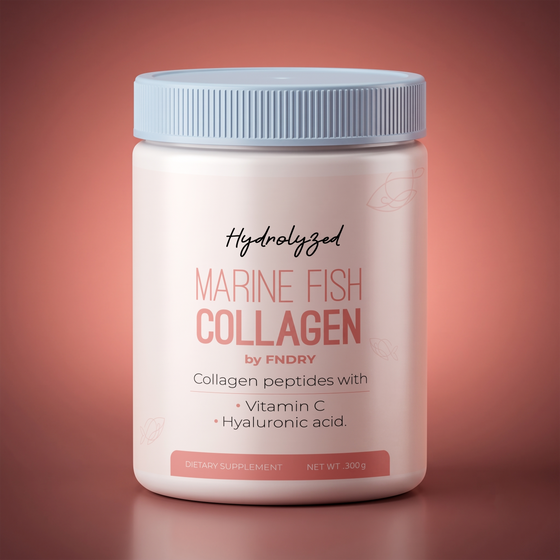
A serving of Marine Collagen + Vitamin C is a single 10 g scoop. Thirty scoops to a tub.
Per 10 g scoop
- Fish collagen peptide
- 4,500 mg
- Acerola cherry extract
- 100 mg
- Vitamin C
- 100 mg
- Sodium hyaluronate
- 20 mg
- Coenzyme Q10
- 20 mg
- Selenium
- 10 mcg
Also contains maltodextrin, sucralose and silicon dioxide. Allergen: fish.
Now try to put that in a capsule
A size 00 capsule — about as large as most people are willing to swallow — holds well under a gram of powder. How far under depends on how densely that particular powder packs, so treat a gram as a generous ceiling rather than a normal figure.
Use the generous figure anyway. The collagen peptide on its own is five capsules. At the more usual half to three-quarters of a gram it's six to nine — and that's before the vitamin C, the acerola, the hyaluronate, the CoQ10, the selenium, or anything a powder needs in order to move through a capsule machine at all.
So the choice was never powder versus capsule. It was 4,500 mg in a scoop, or a smaller number in a capsule and a different product.
A dose you don't take isn't a dose — and six capsules a day is a hard routine to keep.
"I'll never remember a powder"
That's the obvious objection, and it has it backwards. A powder has to go into something — which means it attaches to something you already do rather than becoming one more thing to remember. One scoop into the coffee you were making anyway, stirred, done. Nothing to reorganise, nothing to give up.
The reason we're this fussy about the habit: a supplement is something you take every day, and twelve weeks is 84 mornings — three tubs. That only happens if the scoop is genuinely easy.
What this doesn't mean
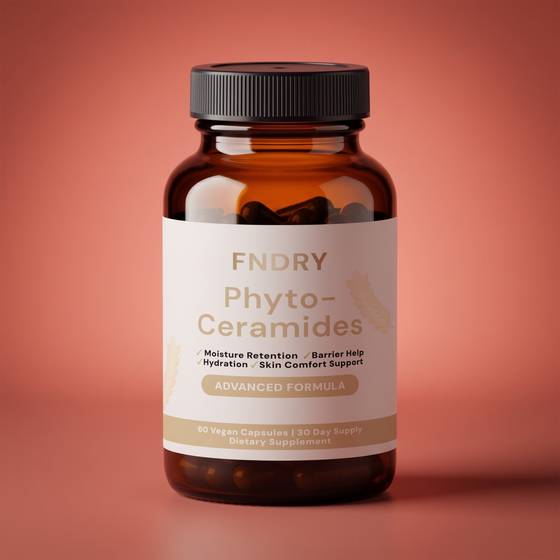
Powder isn't better than capsules as a rule. It's better when the dose is large. Where a dose is measured in milligrams a capsule is the right answer, which is exactly why the other three products in the range are capsules and softgels. The ceramides are an 840 mg daily complex — that fits into two small capsules with room to spare, and making it a powder would be a worse product, not a braver one.
The other half of the argument
Size is only half of it. The rest is what the 4,500 mg is standing next to. Vitamin C is in the same scoop because the body needs it to form its own collagen* — that's a different argument and it has its own article.
Together they're the reason this is the one product in the range with a formula story, not just an ingredient.
Do the arithmetic, then compare
Every number above is read off the pack, and you can check the rest of the range in the same detail in the ingredient library. If the capsules in your cupboard came up short, Marine Collagen + Vitamin C is 4,500 mg in one 10 g scoop, thirty scoops to a tub — the full dose, in the one shape it fits, at $1.33 a day.
Marine Collagen + Vitamin C contains fish and is not suitable for vegetarians. Supplements are there to support a diet, not to replace one. *These statements have not been evaluated by the Food and Drug Administration. This product is not intended to diagnose, treat, cure, or prevent any disease.


